
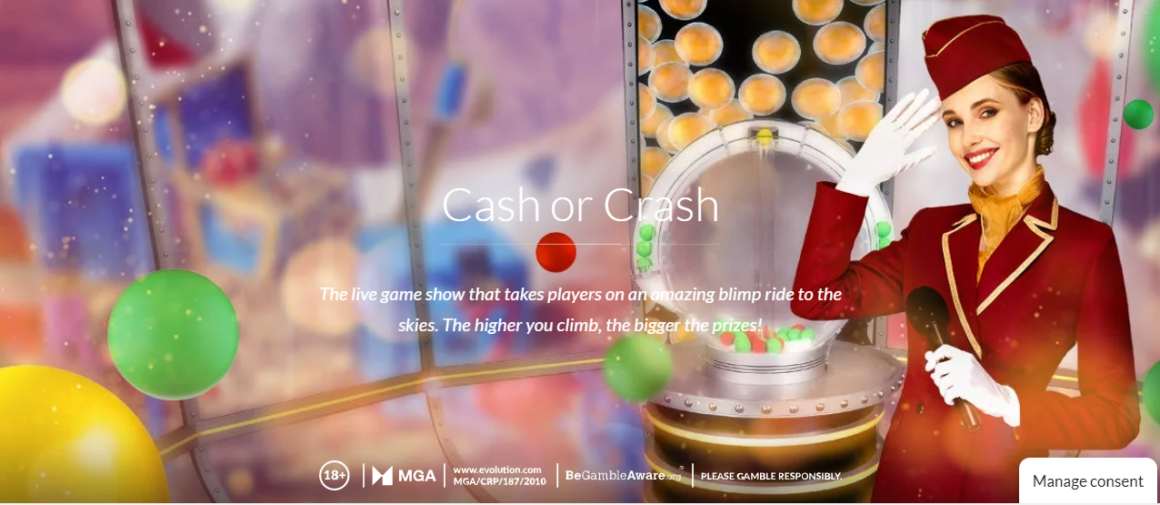
In online live casino games, a product has to hook the viewer right from the start. For the UK market, Cash or Crash Live delivers a look and feel that merits attention. Its design isn’t just for show. It works as a functional system, built to handle the game’s tense, multiplier-driven action using transparent feedback and dramatic tension. The UI is the immediate bridge between user decisions and the game’s uncertain narrative, making its efficiency crucial. This review will deconstruct the design, examining how color, layout, info architecture, and animation combine to create something that feels straightforward for beginners and compelling for regular players.
The Main Aesthetic: A Contemporary Aviation Theme
Cash or Crash Live makes its identity clear from the start with a coherent aviation and travel theme. This functions as a metaphor for the game’s journey of growing risk and possible reward. The studio backdrop employs dark tones, suggesting a private jet hangar or a premium airport lounge, with muted metallic finishes and soft ambient lighting. This environment is a intentional choice. It evokes feelings of luxury, precision, and adventure, which fits neatly with the high-stakes play. For UK players accustomed to high-quality production in their entertainment, the setting seems both familiar and upmarket. The look steers clear of cartoonish or silly elements. Instead, it pursues a sleek, contemporary realism that lends the game weight and credibility, positioning the financial decisions as serious business occurring in a stylish space.
Usability Factors for a Larger Audience
Live casino games offer some inherent challenges for accessibility, but Cash or Crash Live includes several well-considered design choices. The high contrast between text, UI elements, and the background aids users with visual impairments. Clear, symbolic icons paired with text labels support understanding. While the live host’s audio is a central part of the show, most critical game information is also displayed visually. This offers a redundant channel for players with hearing difficulties. That said, there is space for more progress. More detailed alt-text for dynamic game elements or scalable interface options could be added. For a UK operator, meeting and surpassing evolving digital accessibility standards is not merely the right thing to do. It also opens up the game to a broader audience, making this a continuing priority.
Typography and Clarity When Stakes Are High
When a live game moves quickly and money is on the line, information needs to be instantly readable cashorcrashcasino.eu. The typography in Cash or Crash Live handles this perfectly. It relies on bold, crystal-clear sans-serif typefaces, especially on small smartphone screens. The multiplier and bet numbers, appear as oversized, thick numerals. This makes them the most prominent visual element on screen. Explanatory tags and additional copy employ a thinner typeface yet maintain high contrast against the dark backgrounds. Organizing text by importance directs the viewer’s gaze from the key information—the potential payout to the secondary information. This approach eliminates all ambiguity, a critical necessity for ensuring honesty and clarity in a real-money game.
Animation and Feedback for User Interactions
Every single move a user performs in the Cash or Crash Live interface gets an exact, meaningful visual as a reaction. This reaction is crucial. Betting generates a subtle but confirmatory visual cue, like a highlight or a gentle pulse on the token. The most significant animations are kept for the game’s key moments. The multiplier increase could be presented with an ascending graphic or a fast-spinning counter, which builds suspense. The ‘Crash’ event itself receives a purposely abrupt motion—perhaps a display tremor or an explosion—that vividly conveys the moment of loss. On the other hand, a successful withdrawal is greeted with affirmative, positive effects. These effects are not simply ornamental. Such visual cues are a core part of the user experience, transforming abstract outcomes into concrete and instant feedback. This raises the emotional stakes.

Color Scheme and Its Emotional Influence
Cash or Crash Live employs its colour scheme with a clear purpose. Deep blues, charcoal greys, and clean whites dominate, forming a calm and focused backdrop. These cooler colours act as a neutral canvas, which renders the strategic pops of accent colour much more effective. The ‘Cash Out’ button, for example, usually uses a assured, reassuring green. Warning signals or the ‘Crash’ moment itself might flash with urgent reds or oranges. This colour coding operates on instinct. Green suggests safety and profit. Red signals danger and a full stop. For players in the UK, where visual signals in games are often quite uniform, this intuitive design speeds up the learning process. It lets universal colour associations direct the emotional response, which intensifies the narrative tension of every round.
Game Layout and Data Hierarchy
The screen design splits the screen into defined sections, putting the most important information first without cluttering the view. The primary focus is the live broadcast showing the presenter and the playing area. This preserves the live interaction and the core gameplay prominently displayed. Critical details—the multiplier value, the total bet amount, and the potential win—shows up in simple, bold font on minimal boards, usually at the top or sides of the screen. The design ensures that during the key moments when a user must choose to ‘Cash Out’ or try the ‘Crash’, all the vital facts are immediately visible in their direct sight. The grouping makes sense: stake settings sit apart from play data, and support menus are simple to locate but don’t get in the way. This clever spatial layout minimizes mental strain, allowing players to focus on their tactics and the building tension.
Responsive Design and Multi-Device Experience
A large part of the UK market plays casino games on mobile devices, so a consistent experience across different devices is vital. Cash or Crash Live demonstrates strong responsiveness. Its interface adjusts gracefully to match various screen sizes and orientations. On a mobile, the layout often transitions to a more vertical stack, placing information panels above or below the main video feed to provide the action as much room as possible. Touch targets, like buttons and sliders, are built large enough for easy finger use. Significantly, the game retains all its features and visual clarity no matter the device. Nothing is compromised on a smaller screen. This consistency guarantees a player can transition from their desktop to their phone without having to figure out a new layout, a key factor in maintaining players happy and returning in a mobile-centric world.
Comparison with Competing Real-time Entertainment Shows
In competition with other popular live dealer game shows available in the UK, Cash or Crash Live’s interface stands out via its concentrated goal and coherent storyline. In contrast to games with intricate bonus wheels or many rounds, its structure is optimized to narrate a single clear story: the ascent and potential fall of a multiplier. This minimalism makes it appear less messy than some alternatives. The aviation motif is integrated into the experience more distinctively than standard studio backgrounds, offering stronger atmospheric immersion. Some titles may offer more frenzied gameplay or a broader selection of betting options. Cash or Crash Live’s user interface excels at presenting one tense dilemma with a film-like polish. It exchanges intricacy for simplicity and a rich atmospheric feel, carving out its own unique spot in the market.
Development of the Design and Future Capabilities
The visual layout of Cash or Crash Live has seen gentle enhancements from its initial release, showing a creative team that listens and adapts. Earlier versions have been tweaked for improved clarity and smoother motion graphics, often based on user feedback and technical enhancements. Going forward, the solid conceptual groundwork gives plenty of room for intriguing additions. One can imagine seasonal or special event overlays—a “space adventure” or “deep-sea expedition” concept, maybe—that could renew the graphics while preserving the fundamental game mechanics. Also, upgrades to streaming systems might allow for more interactive interface elements or personalised visual settings. For the UK audience, which values both innovation and reliable excellence, the key will be to blend any fresh introductions with the clear, simple interface that currently makes the game’s interface so effective.